


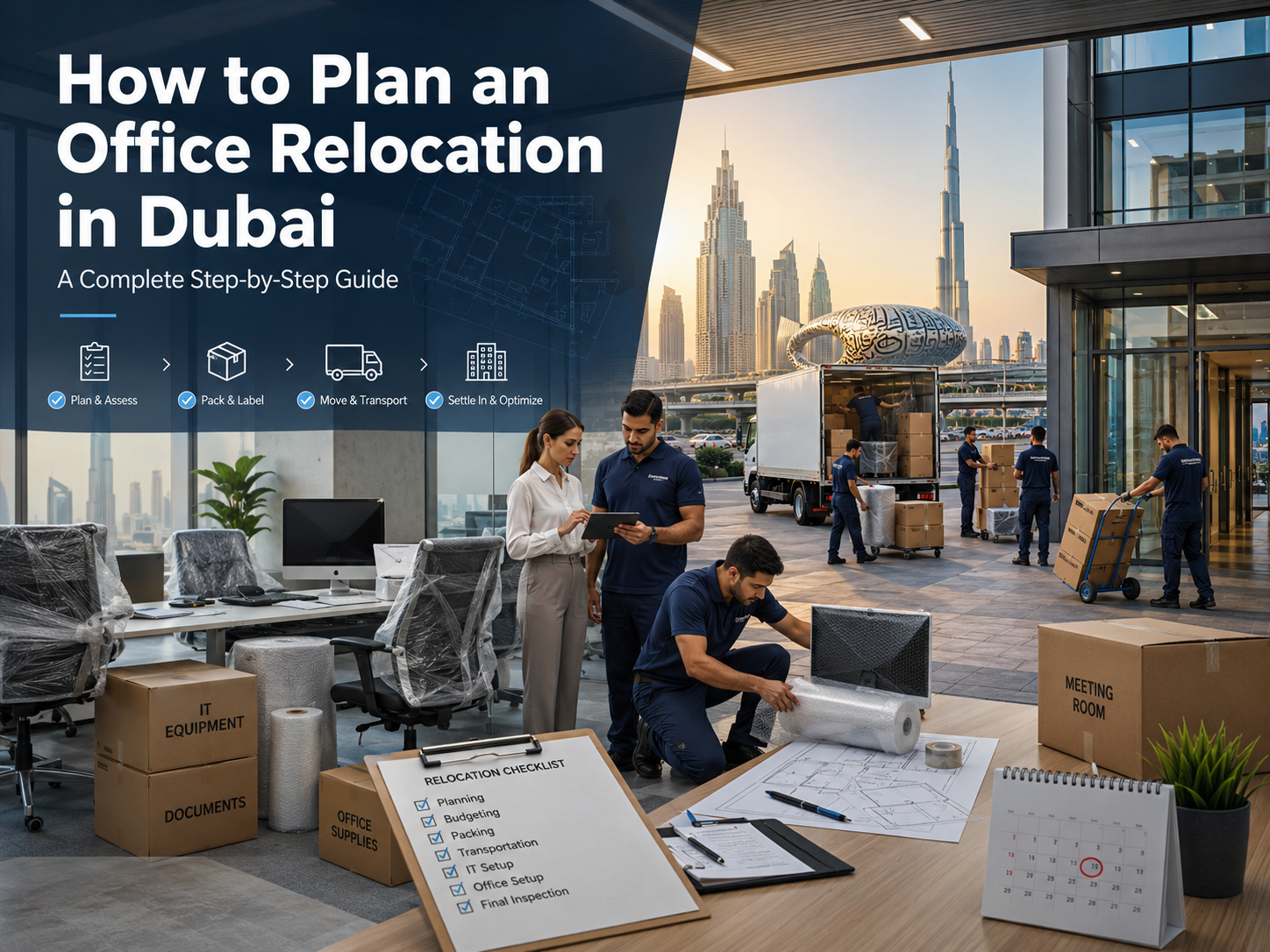
An office relocation in Dubai is rarely just about moving desks and boxes. Between lease timelines, building access permissions, IT infrastructure, and keeping the business running with minimal disruption, a commercial move involves considerably more coordination than a home move.
Whether you’re relocating a small office or an entire floor, having a clear, step-by-step plan is what separates a smooth transition from a chaotic one. This guide walks through exactly how to plan an office relocation in Dubai, from the first planning meeting to settling into your new space, based on the real problems businesses commonly run into along the way.
The Real Problems Businesses Face During an Office Relocation
Before mapping out the plan, it’s worth understanding what typically goes wrong:
- Downtime affecting operations. Moving during business hours, or without a clear IT cutover plan, can leave teams unable to work for longer than necessary.
- Lease and building timing conflicts. Overlapping notice periods, Ejari renewal timing, or mismatched move-out/move-in dates can create gaps or double rent.
- IT and server disruption. Disconnecting and reconnecting servers, phone lines and internet without a plan can cause extended outages.
- Building access restrictions. Many Dubai commercial towers require move approvals, loading dock bookings and restrict moving hours to evenings or weekends.
- Employee disruption and miscommunication. Without clear internal communication, employees may be unclear on the new address, parking or what to pack personally.
- Furniture and equipment damage. Workstations, server racks and office equipment require different handling than household furniture.
Step 1: Set Your Timeline (8–12 Weeks Before)
Start planning early. For most Dubai offices, 8–12 weeks provides enough runway to:
- Review your current lease notice period and new lease start date
- Book a commercial mover experienced in office relocation in Dubai
- Assess IT and infrastructure requirements for the new space
Step 2: Handle Lease, Ejari and Building Notifications
- Notify your current landlord in line with your lease’s notice period requirements.
- Register your new commercial lease with Ejari through the Dubai Land Department.
- Confirm move-out and move-in dates don’t overlap in a way that creates unnecessary double costs, or plan for a short overlap if you need buffer time for IT setup.
Step 3: Plan Building Access and Moving Logistics
Most Dubai commercial towers have specific rules for office moves:
- Loading dock and freight elevator bookings, often requiring advance reservation
- Permitted moving hours: many buildings restrict moves to evenings or weekends to avoid disrupting other tenants
- Insurance certificates or NOC documents required by building management before movers can access the site
Confirm these requirements with both your current and new building management well ahead of moving day.
Step 4: Coordinate IT and Utilities Separately from Furniture
IT relocation is one of the most sensitive parts of an office relocation in Dubai and it deserves its own mini-plan:
- Schedule internet and phone line transfers with your provider (commonly Etisalat or du) well in advance, since installation appointments can take time to book.
- Plan server and network equipment disconnection/reconnection around a low-activity window, such as a weekend.
- Back up critical data before physically moving any servers, as a precaution against handling damage.
- Set up DEWA for the new location ahead of move-in to avoid delays with air conditioning or power.
Step 5: Create a Furniture and Equipment Inventory
- Label furniture and equipment by department or floor plan zone, so placement in the new office is straightforward.
- Flag fragile or high-value items (monitors, servers, glass partitions) for special handling.
- Decide what’s being relocated versus disposed of or donated. Office moves are a natural chance to get rid of unnecessary stuff.
Step 6: Communicate the Move to Employees Early
- Share the new address, parking details, and moving timeline at least 2–3 weeks in advance.
- Ask employees to pack and label personal desk items ahead of moving day.
- If any remote work days are needed during the transition, communicate this clearly in advance.
Step 7: Moving Day Execution
- Schedule the physical move for evenings or weekends where possible, to minimize business disruption.
- Have a designated point of contact on-site at both locations to direct movers and answer questions.
- Confirm IT reconnection is tested before employees return to the new office.
Step 8: Settle Into the New Space
- Walk through the new office to confirm furniture placement matches the plan.
- Test all IT systems, phone lines, and internet connectivity before full operations resume.
- Update your business address with relevant authorities, clients and on your website and Google Business listing.
Local UAE Context
- Ejari for commercial leases: Commercial tenancy contracts must be registered with Ejari via the Dubai Land Department, similar to residential leases and this registration is often required for utility setup at the new address.
- DEWA and Etisalat/du timing: Utility and telecom transfers can take longer for commercial premises than residential ones, particularly for dedicated business internet lines. So book these early.
- Building management approvals: Many Dubai business towers, especially in areas like Business Bay, DIFC, and Sheikh Zayed Road, require formal move-in/move-out permits and loading dock bookings.
- Free zone considerations: If relocating within or into a free zone (e.g., DMCC, JAFZA), additional facility-specific move approval processes may apply. Check with your free zone authority.
- Weekend and after-hours moving: Many commercial buildings only permit large moves outside standard business hours to avoid disrupting other tenants, so factor this into your moving day schedule.
People Also Ask
How far in advance should I plan an office relocation in Dubai? Most businesses should start planning 8–12 weeks ahead to allow time for lease coordination, building approvals, IT planning and mover booking.
How do I minimize downtime during an office move? Schedule the physical move outside business hours, plan IT disconnection/reconnection around a low-activity window and test all systems before employees return.
Do Dubai office buildings require permits for moving? Many commercial towers require a move-in/move-out permit or NOC, along with a loading dock or freight elevator booking, arranged with building management in advance.
Who handles internet and phone line transfers for an office move? This is typically coordinated directly with your telecom provider (such as Etisalat or du), and should be scheduled several weeks ahead since installation appointments can take time.
Should I hire a commercial mover or a residential mover for an office relocation? Commercial movers are generally better suited, since they’re experienced with IT equipment handling, building access protocols and business-hour scheduling constraints.
What is the biggest risk during an office relocation in Dubai? Unplanned downtime. Usually caused by IT disconnection issues or lack of building access coordination. This is the most common and costly risk.
Do I need to register my new office lease with Ejari? Yes, commercial leases in Dubai are registered through Ejari via the Dubai Land Department and this is often required for utility connection at the new address.
How should I communicate an office move to employees? Share the new address, moving timeline and any operational changes at least 2–3 weeks ahead, giving employees time to plan and pack personal items.
Expert Insights
- The defining challenge of an office relocation in Dubai isn’t the physical move itself, it’s coordinating IT, building access and lease timing without disrupting business operations.
- IT relocation deserves a separate plan from furniture moving, since downtime here has a direct and immediate business cost.
- Building management requirements (permits, loading docks, moving hour restrictions) are a common source of last-minute delays if not confirmed early.
- Employee communication is frequently underestimated, a clear timeline reduces confusion and keeps the transition smooth on the ground.
- Commercial movers with Dubai-specific experience typically understand building protocols and IT-sensitive handling better than general movers, which reduces coordination overhead for the business.
Comparison Table: Weekday vs Weekend Office Move
| Factor | Weekday Move | Weekend Move |
|---|---|---|
| Business disruption | Higher, unless done after hours | Lower, minimal operational impact |
| Building access availability | May be restricted during business hours | Often preferred/required by building management |
| Mover availability | Generally easier to book | May require advance booking |
| IT cutover risk | Higher if done during active hours | Lower, more testing time before Monday |
| Employee readiness | Requires clear same-week communication | More time to prepare over the weekend |
Office Relocation Checklist
8–12 Weeks Before:
- Confirm new lease and notice period on current lease
- Book a commercial mover experienced in Dubai office relocations
- Begin IT and infrastructure planning for the new space
4–6 Weeks Before:
- Register new lease with Ejari
- Confirm building move-in/move-out permits and loading dock bookings
- Schedule internet and phone line transfer
2–3 Weeks Before:
- Communicate move timeline and new address to employees
- Create furniture and equipment inventory with zone labeling
- Set up DEWA at the new location
Moving Week:
- Back up critical data before server relocation
- Confirm moving day schedule with building management at both sites
- Assign an on-site point of contact for moving day
After the Move:
- Test IT systems and connectivity before resuming operations
- Walk through the new space to confirm furniture placement
- Update business address across your website, listings, and official records
Common Mistakes
- Starting the move plan too late, leaving insufficient time for building approvals and IT coordination.
- Treating IT relocation the same as furniture moving, without a dedicated backup and reconnection plan.
- Not confirming building move-in/move-out permits early, risking last-minute access denial.
- Underestimating employee communication needs, leading to confusion on moving day.
- Booking a general mover without commercial/office relocation experience, resulting in mishandled equipment or missed building protocols.
Pro Tips
- Ask your commercial mover directly about their experience with office relocation in Dubai, including IT-sensitive equipment handling.
- Schedule your internet/phone transfer as early as possible — this is often the longest lead-time item in the entire plan.
- Do a full systems test the evening before employees return, not the morning of, to catch issues with buffer time.
- Use the move as an opportunity to declutter and donate or dispose of unused furniture and equipment.
- Keep a single shared moving timeline document accessible to both your internal team and your moving company to avoid miscommunication.
Frequently Asked Questions
The physical move itself often takes one day for a small-to-mid-sized office, though full planning and settling-in typically spans several weeks.
Many commercial movers offer specialized handling for IT equipment, though it’s best to confirm this specifically and coordinate data backup separately.
Many moving companies offer transit insurance for commercial equipment; it’s worth confirming coverage for high-value IT and office assets.
Short-term storage is often available through commercial movers to bridge any gap between move-out and move-in dates.
Weekends generally minimize business disruption and are often preferred by building management for large commercial moves.
Look for movers with specific office/commercial relocation experience, transparent quotes and familiarity with Dubai building access protocols.
A successful office relocation in Dubai comes down to early planning, clear coordination between lease timing, building requirements, and IT systems and proactive communication with your team. Businesses that treat IT relocation and building access as separate workstreams. Rather than an afterthought, consistently experience smoother transitions with far less downtime.
If you’re planning an office relocation in Dubai and want a team experienced in commercial moves, building coordination and IT-sensitive handling, Desert Movers UAE is ready to help make the transition seamless.
Planning an office relocation in Dubai? Get in touch with Desert Movers UAE for a detailed commercial moving plan that minimizes downtime and keeps your business running smoothly.
Get in touch with Desert Movers Dubai – Movers & Packers, Relocation & Storage (Dubai)
- Email: info@desertmoversdubai.com
- Phone: +971507663706 / +971503026866
- WhatsApp: +971507663706
- Landline: +97142232795
- Website: www.desertmoversdubai.com